Wednesday, July 22, 2015

The Serial Craze: When Writers Sacrifice the Story

Not so many years ago, one could view a television drama or pick up a novel, and expect to be told a story.  A complete story. Beginning, middle, end. Can you imagine?  With the exception of daytime soaps, serial stories were the exception, not the rule. As we have entered an era where, across many entertainment platforms, serials are more common - books, movies, television, games - it has often occurred to me that this practice has hurt the quality of stories.

The first time I remember being bored by the serial thing was with the ABC television serial from the 1980s, Twin Peaks. I watched most of it, but grew increasingly annoyed as my writer's intuition (and experience) told me that there was no ending. We were all waiting week after week for a big fat nothing, because the writers hadn't a clue how the thing was going to play itself out. They were making it up as they went, and their ever bringing it to a conclusion seemed to depend upon how long the network was going to keep renewing its call for new episodes.

Apparently I wasn't alone; early in the first season viewership dropped off dramatically. Largely due to great critical reviews based on its innovation, and likely to some ego on the part of ABC, the show was renewed for a second season that proved to be a mess. The key mystery was solved mid-season (a bone-headed decision if ever there was one) and viewership dropped to negligible numbers, financially speaking. The series died a long drawn-out death. Creators later admitted that they never considered that the series was about plot (the murder of Laura Palmer), but more about the interactions between the show's quirky characters - a confession that likely surprised not a single competent writer in viewer land. 

Other shows were smarter; The X Files incorporated a secondary ongoing storyline regarding the relationship between the leads and with their pasts, but still offered a complete story weekly. This was a formula that kept the show alive far longer than producers of Twin Peaks could have dreamt of - several years. 

By the middle of the 1980s, movies that were "sequels" or "prequels" or whatever inanity-du-jour producers came up with were a bit of a joke. (How about that second Indiana Jones story?  The "prequel". Yeah.. that one.) One could expect the sequel to be a lame attempt at money-making on the part of producers, and rarely anything that lived up to the thrill moviegoers had at the original. 

In recent years, the serial craze has crept into the realm of novels. Interestingly, many of the classic novels that we still revere from the late 18th, 19th and early 20th centuries in American and British writing were originally published in serial form in various newspapers. And yet, even that took a different form than it does now. These novels were complete and promised to be so from the beginning: they would be advertised as for example "a novel in four parts".  The reader was reassured every time they began a new installment, that they were reading a real story with a real, logical plot, and that it would have a real ending.

Nowadays there is a lot of laziness in writing all around. While Amazon, I personally believe, has been a godsend in allowing innovative stories to find a place in the marketplace, I abhor the laziness - from people just wanting to make a quick buck who would not take one week to learn to write a plot in any coherent manner, to people who want to call themselves a writer but don't understand that putting a book out there with grammar and spellings issues and a mess of a structure does not a writer make. Of course, the buyer is as responsible as the writer, if not more, for this state of things in the marketplace - and that is another discussion. The point is, I have come to believe that writing serials is another rather cynical attempt to make money with bad writing.  One need only slap together the beginning of a story, and put of having to take it to a logical end. 

Why does this matter to me?  Because 1) we have so little in the way of novels of quality on the already flooded market, and 2) serials as they are currently being presented cheat the reader. And do that quite intentionally.

The best plots - and in my mind the only way to structure a novel - consider the outcome as they go. The author knows the ending and the conflicts and pitfalls, and leads the reader through a maze of clues (foreshadowing) that all contribute to the satisfaction a reader feels as they reach a great ending. If the writer from the get-go has no idea what the plot is or where the conflict is going, they cannot foreshadow, they cannot tease and lead the reader. To me, there is something really low about spoonfeeding a reader little bits of an incomplete meal of a story, allowing him to anticipate for nothing.

Call me old-fashioned, but I believe that whether you are a novelist or a playwright, a screenwriter or a producer for TV, you owe those to whom you are telling the story a well-structured plot. You owe this above all else, because without a good plot, the story doesn't take shape. I talk to too many writers who will tell me all about the great protagonist they have dreamt up for the upcoming series (usually this protagonist is based upon themselves, interestingly), but are unable to articulate any coherent plan for a plot.  "It's a series," is the excuse, "I can figure it out in Book Two."  Oh.  

The problem is, there are too many instances where the first book establishes the lead character and a conflict of sorts, and ties up just a few loose ends by the finish but leaves a few bigger loose ends for the second book, enticing readers to buy in order to be fulfilled. Fine, but too many times the author grows bored by the end of the second book, resorts to dragging it on to a third, or simply doesn't publish a book with the ending. (Can you spell "c.h.e.a.t."?) So what starts out as an enthusiastic following results in a lot of frustrated readers, and rightly so. The author struggles to keep plotting alive, the second and subsequent (God forbid) books lack quality, and the series fizzles out. The problem is that the writer didn't take the time and effort - and perhaps lacked the skill in many instances - to lay out a complete plot structure, and then figure out what would happen in each book.  Experienced writers (and most of them stay away from serials) don't make the mistake of making it up as they go - they know that unless you have plot issues resolved from the beginning, they become potholes that grow into craters, and you may end up without an ending that works, and a failed series.

I find that this scenario usually involves an inexperienced writer, eager to make a paycheck, and unschooled on the finer points of successful plotting.  Often, this is a writer who does characterization well; he or she can come up with a great character and stick them into a book. But that character ends up throwing up his hands and complaining to the author, "What do you want me to do?"  when he becomes hopelessly mired in the chaos of a lack of plot.

A few people - a few - who are experienced writers do serials well. But the ones I can think of all do one important thing that is different from inexperienced writers:  they roll a complete well-plotted story into each book. Each book can stand alone as a good read. And a person can read Book Three and pretty much enjoy a full story, never having read the first two at all.

One good example of this is the wonderful historical novelist Bernard Cornwell. He has done a few different series of novels designed around themes. Each book within a series is a separate story; it may involve an ongoing protagonist observer to the historical period. Bestselling thriller writer Tom Clancy uses the Jack Ryan character as a protagonist through many of his novels, yet each novel contains a complete mystery thriller. Another good example is the Harry Potter series by J.K. Rowling. Each story could be read separately and is complete in and of itself.


Unfortunately, the success of Harry Potter spawned a generation of novels that are badly written as series. Either, as mentioned above, an inexperienced writer is just in over their heads - or worse, the success of a first book prompts the writer to come up with an extension to the story that is never going to live up to the first because the writer doesn't understand the sophistication of plot structure required to pull it off (consider the Twilight story by Stephenie Meyer, or the 50 Shades of Gray books by E.L. James - yes there are three of those trainwrecks). 

The genre of erotic novels, along with "urban fantasy", offers up some of the worst nonsense in series reading. There, you often experience both bad characterization and bad plot structure, all rolled up in one. Why any reader continues to finance an author who can't be bothered to offer those two fundamentals to the reader, is beyond me. 

I'll continue to be annoyed by series writing, and dismayed that it seems to indulge a sort of greed amongst some bad writers, as their naive readers snatch up the first few books in a series before becoming disappointed.  I'll continue to tell the inexperienced writers I work with as an editor that series writing is not a good idea unless you are willing to plot out three novels, before writing a word of the first. You have to be willing to put thought into the last chapter of the third book, before you can presume to be able to successfully write the series or understand character development and conflict - those very things that form the true backbone of good writing and a successful series. 

I'll continue to believe that it's a trend whose life will be limited as people become tired of disappointment. When that day comes, there will be a lot of nervous TV writers, novelists and screenwriters, who will finally have to learn to write a structured plot!

Tuesday, May 5, 2015

Toward Better Writing: When Crazy Just Doesn't Cut It


Clowns and puppets. Back about ten to fifteen years ago, I noticed a trend in novels that I found infinitely annoying, and I have finally put my finger on why. I hope my observations might be useful.

It got to be predictable, particularly in the literary novel genre, particularly the best-sellers. Nowadays, you find it across genres. Characters had to be outrageous: they had to have almost unbelievable backgrounds; they had difficult to understand dilemmas, usually due to extremely far-fetched situations; they had names that ranged from sounding as if the authors' four-year-olds made up while munching on cereal at breakfast, and sounding as if the author had had one too many cocktails while sitting before the computer. Each of these characters was peppered over with a plethora of quirky habits. These aren't characters; they are so overly made up, so painted with pretty colors, you can't see their faces or souls. They are clowns.

Now you may ask, "What's wrong with that? Crazy characters are fun, Lichen! Some of the best and most memorable characters are like that! You snob!"

This is my problem with it: when you overdo it, you murder the very reasons you might successfully employ it as a creative device. You defeat the purpose - what might have been successful and interesting and drawn the reader in, in a more powerful way. You dilute that which you might have had.

This is why:

First, it is essential to a well-drawn character that your reader is able to relate in some way to her needs or frustrations or experiences or motives. I believe that is always necessary to a successful story. Now, your character might be non-human; he or she might be an anti-hero, possessing what many of us would see as negative traits; he or she might exist in an alternate universe or a time in the far past or distant future that you can't completely imagine. But that character must have traits at his or her core that the reader can relate to on a personal level. The reader must feel, in some important way, at one with the protagonist.  If this doesn't happen, the writer risks losing the reader - either in the bookstore reading the back cover and rolling his eyes before he puts the book back down, or sighing and tossing it aside in the third chapter as he sits on a sofa. A character is too far-fetched when he is made up of so much bizarreness (yes, I made that up, but it works here!) that the reader never bonds with him.

On the other hand, a character must possess some idiosyncrasy in order to be a character, and not a mannequin devoid of personality. Every elementary creative writing class teaches you to find something different to add to a character, in order to make him come alive. Maybe he can favor blue shirts only; maybe her shoes are always untied or her red curly hair always unruly; maybe he speaks with a brogue or a southern American, or British accent. Maybe she has lots of dogs or cats. Or walks ten miles to work every day. No one is interesting if they are like everyone else in the world, right? So a writer must find what can be unique about the character and emphasize that, in order to draw in the reader's interest.  But . . . too much weirdness, too many quirks, causes a character to feel overdone, overcooked, contrived, and well. . . phony. This is when the reader starts to disbelieve in the character. And thus lose interest in the character's plight. Bad news for your book!


In the art of writing for the screen or stage, when we learn the basics of plotting (and of course all of this applies to a novel or short story) we speak about the element of Suspension of Disbelief.  Have you ever been sitting in a theatre to see a play, and as the curtain rises you see that the set is very minimalist - maybe just a few chairs where you know there should be an entire room. Or a character's walk through what is supposed to be a forest, is a few risers or a ramp and some shadow scattered about the stage. But later in the production, you might realize that you have lost track of your initial worry about the set, because you have been engrossed in the story.  This is due to successful performance of a successfully-constructed script. The director, actors and writer(s) have achieved Suspension of Disbelief for the audience. In other words, the elements that might have caused the audience to disbelieve the story as it goes have been overshadowed by the larger story itself. The reasons for the audience to believe the plot being set before them - the obstacles before the characters and the motives they have as they fight for that which they desire most - are so powerful, that anything prohibiting that tendency to question, has been obliterated for a time.

Or have you ever sat and watched a film, and thought to yourself, "This is so stupid. This person would never do that. People don't act like that." You are bothered because the Suspension of Disbelief has not been successfully achieved; those elements that cause doubt in your mind have not been overcome by the plot or performances, and thus the film has failed to properly engage your imagination.

When you throw in too much of the bizarre into a character, your reader's ability to employ Suspension of Disbelief is impeded. If the reader already doesn't find your character believable (and to be relatable she must be a little believable after all!), why would he believe your plot?

To put all this simply: don't write characters that are so overboard weird that they sink into seeming silly. That is easier said than done, if you are a writer that loves quirkiness. So in the interest of the writers out there who may be in love with the Weird, let's set down some common sense guidelines:


  • If you are going to name people silly names from the depths of your imagination, do that to only one character. One character with a silly/quirky nickname or a name that only they could have inherited from Great Grandpappy Pinecone, is enough.  Let people around that character have more mainstream, geographically/ethnically/era appropriate names. That way, your odd character really stands out and your story doesn't seem populated by people your reader can't relate to or believe (and if everyone in town is named ridiculously, can the reader believe the town is well. . . sane?).  An exception would be a group of siblings who were all given odd names to make a point, and in order to allow you to say something about family dynamics. 
  • And let's say you do that. You have three sisters all with silly names their perpetually-drunken sire insisted upon. Then do it, but have one of them comment on the names within the narrative, because if the characters themselves acknowledge the ridiculousness, the reader will respect them and accept the reasoning, and thus believe in them and in the story. 
  • Don't give your character fifteen quirks. Give him three, tops. Those three will stand out enough, will keep your character within the bounds of logic, and allow him to still be believable if a little . . . unique. 
  • If you are giving your character an odd name, inexplicable quirks, and a crazy family, for Heaven's sake, make his background and dilemma believable.  Not that there is ever an excuse for a badly-constructed plot, but especially when you are demanding a lot of Suspension of Disbelief of your reader in the way of your character's very construction, do allow him a relatable situation to deal with.
  • Keep this in mind:  Most of us in our day-to-day lives are a little (or a lot) turned off by phoniness. We can smell it a mile away by our thirties or so. And it bores us. Phonies wear a smell of trying too hard, of displaying their oddness like a badge, along with a silent, "I'm too cool for you all. . . see how weird I am?"  You know what I mean. Don't let your characters be that. Keep them real. Write a real character who happens to have an odd name and be dealing with a weird life circumstance. Don't use a character to parade around your favorite weird name, personal quirks, and idea for the weirdest plot ever. That is phony, and it isn't going to lead to good writing. Believe me on that. Don't make a character your puppet. Rather, write a well-rounded, believable, relatable character from the beginning and then let the character carry the story. You record the actions of the character as he guides you, you don't manipulate the strings.
  • Cardinal rule: When the author is trying too hard to be cute, the readers feel it. Leave that in fifth grade, and just write a character the reader can respect (not necessarily like, but respect) and relate to in some major way. 
Respect your characters enough - whether they be animal or human, alien or not - to make them real so that the reader is drawn to them.  Bring each to life with a few points of uniqueness - a few odd habits, a few favorite turns of phrase, an interesting family member or two, one slightly odd experience in their past. Stop there. That's enough. 

Know when enough is enough, and never forget that less is more. And over-the-top is . . . well . . . just annoyingly hard for your reader to swallow. 


For more on writing good characters, see previous article: Characters: The Inspiration of Attraction.


Thursday, February 5, 2015

Film Review: The Riot Club

I have been looking forward to seeing this film for quite a while. It is based on an award-winning play, POSH, by British playwright Laura Wade. As did the play, the film has garnered some good reviews, and in particular, its ensemble cast of ten of Great Britain's best young male actors have received positive attention for their roles. As some of you know, I became a fan of upcoming actor and former model Max Irons, after seeing his performance as King Edward IV of England in made-for-cable miniseries, The White Queen. His performance has been one of those singled out for praise in The Riot Club. And so I was excited to see him in this film. Because I am a fan of stage plays, and fascinating by the art of writing for theatre, I am always interested to see how a play has been adapted for the big screen.

The Riot Club was released first in the UK, and subsequently across Europe from early fall until present. The cast and producers have put in a lot of time with personal appearances at various premieres, and it has been met with good energy everywhere, including in Canada where it premiered at the Toronto Film Festival in November of 2014. Its U.S. release is set for late March. It was directed by Danish director/producer Lone Scherfig.

The film is well-produced and adequately filmed. Not one performance is lacking, from the least - lasting a few seconds - to those of the ensemble cast of eleven men and two women, each of whom plays a major role. I found the structure of the plot rather odd, and had to settle in a bit to it: this was no doubt a result of the adaptation from stage. I'm not certain whether editing could have remedied the feeling that the build-up was too short and the debauchery scene very long. It seems that the balance achieved was necessary to the success of the plot.

The story follows two freshmen at Oxford University, Miles (Max Irons) and Alistair (Sam Claflin). Both
Sam Claflin (left); Max Irons
are approached almost immediately by a mysterious underground by-invite-only "social club" known as the Riot Club - named after a 17th-century nobleman who engaged in abandonned and continuous debauchery, and was stabbed in the stomach for it by a cuckholded husband. The boys see this history as terribly romantic and exciting and use it as an excuse to engage in a carpe diem lifestyle while at school which includes playing various pranks that are so extreme that they are more disgusting than amusing. But these kids are rich, and it's old money. They simply pay their way out of scrapes with wads of bills from their pockets and the help of Daddy's lawyers.

I know, you're imagining the horror stories we hear coming out of frat house hazings, right?  In most countries, the children of the financial elite sometimes get away with horrible behavior, and pay and/or intimidate their way out of it. But forget all that: the antics of this crowd would make the most hardened frat boys' jaws drop. They are truly out of control. The viewer feels the situation veering out of hand from early in the film, and the thing is that it never really careens until all Hell breaks loose well past the hour-long mark - it just crawls slowly to an increasingly dark inevitability, and it keeps the viewer mesmerized. It is the horror show you can't look away from - even as you know you don't want to see it.

Stories came out of the set during production that the cast itself was often uncomfortable with the subject matter. The male ensemble discussed it together at length, took time to bond so that filming the worst would be easier on them mentally. Actresses Holliday Grainger and Jessica Brown-Findlay have spoken about struggling with the tension of the misogynistic scenes in the film. Max Irons has told the press a few times that when first presented with the script, he felt he would decline the role, feeling that he didn't want to do something "so disgusting". But he thought about it further, considered that clubs such as the one depicted in the film have been the stuff of university legend for years;  a few years back some of the elite in the British government were discovered to have participated in such behavior themselves, and there was quite the scandal at the time. Irons decided that it was "an important story" and "a discussion that needs to happen" in the greater social context, and he agreed to participate.

Much is made in the film, and during interviews with the cast and director, about this social context. Most of Europe is deeply entrenched in the realities of social class differences, to a greater extent than Americans and Canadians experience. It seems to infiltrate so much of the way of looking at life. I say this as one who has lived in Europe, and was married into a European family for near two decades. To understand - as we do in America - that a lot of money brings what is sometimes too much privilege, and to as a Brit understand it as a sort of wall built over hundreds of years that cannot be scaled, is two different sensibilities.  And so perhaps my appreciation of the film from that perspective was a bit limited.

I think that perhaps my experience of the film was also affected by my gender. Why is it that young men, when they assume their ugliest personas, have to be so damned ugly toward women?  It would be funny if it weren't so horrid: the notion that a male somehow raises himself in the eyes of other males by demeaning those most vulnerable to testosterone-out-of-control, is something I have never been able to understand. The scenes which depict this particular behavior are so vile, that Holliday Grainger describes a sort of dream state she entered during filming the worst, when the line between what was the set and what was real seemed to blur. At one point she describes how one of the actors laid a kind hand on her to ask if she were all right, and she shivered, unable to stand him touching her. She rushes to explain that all the male actors involved were kind people and spoke of their own disgust as well, but it didn't make the filming of it any easier.

Of all the heinous behaviors depicted in the film, perhaps this one was the worst: the harassment of
women. Let me describe what I mean: some of the boys are frustrated that a high-priced call girl they hired to perform oral sex on them all under the dinner table has told them where to stick it (er..them) and walked out without the boys getting their fun. Later, Miles' girlfriend - having been tricked into coming to the restaurant - stumbles upon the drunken orgy at hand. The male mob turns on her, openly taunting her with language meant to intimidate and then terrify her into believing she will be raped, as they physically restrain her (and restrain a horrified Miles, who has let it go this far before trying to intervene). The girl finally escapes, but of course, nothing will ever be the same for the two lovers.

Which brings me to the point of the film. The behavior of the boys escalates over much of the film - each time the viewer hopes that we have seen the worst - and many times it seems that it is in fact enough to get the point - it keeps getting worse. It is ratcheted up yet another notch. Is destroying a working family's place of business enough?  Destroying a treasured collection of artwork? Vomiting under tables? Breaking literally everything in a room?  Is humiliating an escort enough?  Or a young woman who means no harm, and comes into the room expecting no harm to herself? Is terrifying her in an intimately, primal sexual way for one's amusement enough? How about beating a man senseless, as a gang, because you can?

As I write, it's been one day since the world was horrified by the act of a terrorist gang of thugs in Syria burning a young man alive in a cage. This gang has, over a year, gotten more and more brazen in terms of how it tortures and kills. From hangings to beheadings. From stonings to throwing people off buildings. And now we are back in the Middle Ages, burning people alive. As one news pundit said today - we have to understand that these are young men who are enjoying what they are doing. They are enjoying the victim's suffering and they are enjoying the horror we feel at seeing what they have done.  I thought a lot about this as I watched The Riot Club.

I thought about the nature of power - whether political or monetary, by virtue of terror or by inherited wealth.  I thought about human nature too.  I thought about what Miles' girlfriend says to him, tears streaming and body shaking, as she throws cold water on his effort to seek her forgiveness, "You were THERE. You had a choice, Miles, and you chose to do NOTHING."

The ugliest behavior humans can engage in are wrapped up in the under two hours of this film. When intimidation and power is used to destroy another - whether by the horrible psychological torture suggested in this film, or by setting fire to a person - I have to believe that the gods weep for us all: both for those who do it, and those who stand by and do nothing.

In the end, what is really the difference between the minds of young men engaged in a gang rape or beating a man blind in the back room of a pub, and the minds of a Middle Eastern thug?  What are we going to do about these acts, in our own societies, behind the doors of our governments, and within our universities? How much is too much for us as a species to bear, before we stop turning our faces away and excusing it? Before we stop refusing to be emotionally present, before we stop doing nothing?

These are questions this haunting film leaves us. I didn't enjoy it. I never want to see it again. But I'm glad I did see it once, and that it made me think about things that perhaps we all should be giving thought to from time to time.  As Mr. Irons observed, the story is important on many levels, depending on one's perspective, and it certainly is a place to start a much needed discussion. The most relevant films are those that make us look in the mirror, and for that, The Riot Club deserves accolades.


Tuesday, January 20, 2015

Je Suis Charlie: What Does That Really Mean?


Nearly two weeks after the Jihadist-driven massacre in Paris that took the lives of seventeen sane, innocent people and a few monsters, the fallout has left me a bit baffled.

"All is Forgiven" ;  "I am Charlie"
It was no surprise, really, that as the staff at Charlie Hebdo rallied to get out its scheduled issue on time - complete with the usual satirical cartoons - the likes of The New York Times and MSNBC refused to show the cover during coverage of the story, explaining that they didn't want to offend Muslims (translate: hurt anyone's feelings). CNN was even more disingenuous about it: they announced they wouldn't show it without reason, for about two days, then said they wanted to protect their journalists from Muslim attack. Baloney - have they not covered other controversial subjects with no such worries? And after all - what sort of "news organization" are you if you do not take risks? At least one on-air anchor openly stated disagreement with the decision.

Funny thing is . . . no one seems to understand what the cover cartoon was about. I read and understand French well, and it left me scratching my head. I had to laugh when news anchors asked French citizens what they thought it meant, and got everything from nervous chuckles to various lengthy theories.  (In the end, I think the meaning was super-satirical: a crying Mohammad as a joke that Muslims would never feel remorse for the violence they inflict on the West in the name of Islam.)

What is astounding to me, though, as a writer and sometime journalist, is that none of these entities seemed to appreciate what I was taught in Journalism 101: that free expression is sacred, and that it must remain so. Sure . . . they give it lip-service as they link arms and walk a few blocks in a parade/photo op, but how many national leaders, and sadly how many news network editors, really get it?  I had to realize that many really don't.

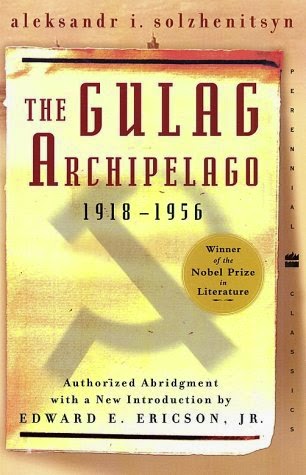
Back thirty-odd years ago when I was a student in the journalism department of a large university, I was assigned a major paper for a writing class. The idea was to learn to write a well-researched 50-pager. I chose to write on Alexandr Solzhenitsyn. He was a Russian writer and social critic. Born in 1918, just as the Russian communist revolution was at an end, he grew up in a world where he was forbidden to write much of what was racing around in his head. But Solzhenitsyn bucked the system and did it anyway. As a result, he spent some time in a Siberian prison camp (he got a good book out of it), and eventually escaped the U.S.S.R. and fled into Western Europe, and after some time, the U.S.  I was twenty-something, and it fascinated me that someone could be punished so brutally for simply voicing an opinion. It fascinated me, and he fascinated me. 

I also was fascinated with the few voices in Nazi Germany who spoke out against the popular regime. Let's not forget that Hitler's rise to power took over a decade . . . during which your average German citizen either was too busy living life to care much about the cancerous elephant in the room, or simply couldn't wrap their brains around the ugly truth of Hitler's aims. So they told themselves it wasn't all that bad, turned their eyes away, and their backs, and well . . . we know how that  turned out.  Those who spoke up, who refused to be silenced against mass opinion, generally ended up dead. But quite a few managed to mess things up for the Nazis a bit before they did.  I understood quite early in my life that these were the lives that mattered in this world - these were the souls that were strongest.  Each time one died, they managed to light a small candle first in a world of darkness - in the form of open speech.  Forbidden speech. 

In early 2012, a teen-aged girl in Pakistan, Malala Yousafzai, was hired to write a blog for the BBC, detailing her life under Taliban occupation.  She talked about their gradual occupation of the valley where she lived, how life became more restrictive and the Taliban patrols more feared. Most of all she talked about how things were changing for women, for girls trying to get an education. Malala loved learning and appreciated deeply the opportunities she had to go to school daily. She was punished for her courage in speaking out, in October of that year, when the Taliban stopped her school bus, boarded and asked for her by name, and shot the 15-year-old girl in the head. All for speaking out about her beliefs. After a long recovery, she continued to speak, even being one of few women to address the U.N General Assembly to speak on the rights of women to education.

There are hundreds of these stories through the time of our history as a thinking, writing, drawing,
photographing, painting, singing  race.  The people in our history who have introduced new ideas, who have spurred the rest of us to think, who have sparked the energy of change for the better, were all such people.  Change is rarely ever welcomed - it is human nature to push back against it; without these brave people to express ideas we have never heard before, ideas that demand thought and social progress, we would stagnate. 

Many of us watched the world leaders (minus our own spineless one) join the millions-strong march in Paris to support Charlie Hebdo and by extension freedom of expression. I had to believe that for many it was a photo op (witness the Saudi leader, having the gall to stand in support of freedom of expression even as his country carries out a sentence of 20 public canings against journalist Raif Badawi for daring to "insult" Islam in his work; or Putin - the thug whose regime murders journalists who get too mouthy). Others likely stood against Islamic extremism without making the connection in their brains that the two issues - Islamic extremism and free expression - were inseparable on that day.

I wonder how many in the crowd really understood it either.  France has a long proud history of fighting for freedom for the individual, and a long history of producing great artists and writers that introduced controversial ideas, and I have to say I'm not surprised that this social explosion occurred in France, of any of the western European countries. But, France has failed to protect free expression to the extent that it should have: it folded to the politically correct left and put in place "hate speech laws".  In the past decade, even Canada - that bastion of liberty - has made the same mistake.  The situation there is such  that an ex-Muslim, having fled the radical religion in his own country, cannot openly speak about his experience in Canada without some whiny leftist having him arrested for "hate speech". 

One day several months back, some worthless piece of dung posted an anti-gay rant on Twitter.  It was picked up by some in the gay crowd, who ranted back that he needed to be "banned from Twitter" for "hate speech".  I made the mistake of pointing out that, in my view, that would be wrong.  Several people threw back at me that what he said was "illegal" and "against the law".  I walked away from it - how to begin to reason with people in that frame of mind?  But he broke no law - he was expressing a free, legal, albeit vile, opinion.  People didn't seem to understand that in the U.S., where Twitter is based, it is not in fact illegal, and that in cyberspace there is no such regulation. 

But for me it was more than  that: this was an example of why free expression matters so very much. 
Let me say here that I understand well, as a journalist, that there are limits to free speech even in
Malala Yousefzai won the Nobel Peace prize at 17, in 2014.
the U.S., which arguably has the most free of speech regulation laws in the world.  You may have heard the joke that you can't yell Fire! in a crowded theatre, unless of course there is an actual fire.  You can't incite a public riot - posing imminent harm to people in a crowd (people in Ferguson, take note). Generally our speech laws reflect caps on speech which would cause immediate physical harm to people.  What we will not put caps on is more telling of American society:  we allow open criticism of government (people in New York, be grateful) in either public discourse or written form; we allow pretty much anything to be said in a novel including criticism and distortion of religions (Dan Brown);  we allow the burning of our own flag; we allow criticism of political ideas in the form of satire - comedy skits (you think SNL would fly in Saudi Arabia?), newspaper columns, and yes, cartoons.  We argue constantly about what to allow on prime-time TV and in feature films. These expressions of creation - good and bad, inspiring or debasing - spur discussion, they invite new ideas, new ways of viewing the world around us.  In this way they stretch our collective creativity and imagination. 

But what about the idiot on Twitter with the anti-gay slurs? What about those of Charlie Hebdo's cartoons that many deem distasteful?  What about the fact that SNL's skits are leftist-slanted?  What about when Solzhenitsyn, from behind the electrified fences of his U.S. home, ranted about the evils of the U.S. in much the way he ranted about the U.S.S.R. (the man was perpetually dissatisfied and angry, it turns out, genius though he probably was . . . )?  Do we have to tolerate speech that is . . . well, worthless?  Destructive?  

I would argue that we do. I would argue that we make a grave mistake when we fail to protect the vilest of speech and this is why:

1 - I truly believe in sunlight as the great disinfectant. Consider the person on Twitter - I suspect it was a 13-year-old trying to get a rise out of a bunch of gay porn stars and pro-gay activists, but let's say for argument's sake it was a 45-year-old business executive and respected member of his town.  I think it's good for us all to see what that man says, see it plainly for what it is, know the disease in our midst and then destroy it with education. If we are never permitted to hear it, after all, we never have to really look hard at its existence.   And. . . when it's out in the open, the person who spoke has to face consequences, has to defend an indefensible stance. That can only be a great exercise. 

2 - Secondly, we cannot with good conscience say that we are a free society that respects varied points of view, and then silence some points of view.  It's hypocritical, and furthermore it is damned dangerous: the more tyrannical regimes in the history of the world did this - a few people decided what everyone should believe and God help those who spoke up with a differing opinion. When we silence any point of view, we imply that only some of us have the right to silence others. This is pompous, arrogant, and invites totalitarian ways of thinking.  If we are a truly equal society, then we don't silence views we don't agree with. 

3 - Silencing unpopular views destroys the possibility for one of those views to change the world for the better.  Does any of us really want to live in a society where everyone agrees?  How boring!  How impossibly bland!  How would we create anything meaningful in such a place?  How would any innovation be born?  As I have already asserted, necessary changes for the better often begin with the spark of an offensive idea - or an offensive political cartoon.

4 - The cool crowd is fickle and their preferences change regularly with the wind. Today, it's not cool to speak against Islam; however it's fine to bash Christianity. Tomorrow.. who knows?  Two decades ago it was risky to defend gay marriage out loud . . . today it's nearly chic. Do you want to gamble that tomorrow the cool crowd agrees with you 100 per cent - because if you allow the cool crowd to always determine what is acceptable expression, and you value being truthful more than being one of the crowd, you may find yourself muted. Defend those who aren't cool today so that tomorrow your voice is safe. Simple.

Some argue that we go too far if we insult one's very religion. Imagine . . . if we outlawed religious critique and discourse, how shallow our philosophical world would become.  The Pope - bless him - got it wrong. His predecessors had the moral courage in the Stalin era to speak out against what they saw as an evil ideology; they did it again in the Nazi era. He might do well to review history. As for pulling our punches when discussing religion and politics, so as not to offend the faint of heart, I am with Bill Maher - whom I generally dismiss as a brainless  twit mind you, but lately have become a bit fond of (I hardly recognize the old guy nowadays . . .) 


A few wise people have pointed out since the Paris march that "free speech" is not made for those whose views are acceptable, but for those whose views are repugnant. This is why Evelyn Beatrice Hall's quote lives on through the decades (no, it was not Voltaire!): "I disapprove of what you say, but I will defend to the death your right to say it."   I was deeply offended by the rant on Twitter against so many of the people I love in the GLBT community, but I do not want to see that account banned for the same reason I don't want the vilest of rhetoric from Jihadists using Twitter to recruit banned - I want it right out in the open to be seen for the filth it is, and I want us all to have to consider it in its existence, and form our own moral code accordingly. I value an individual's right to free expression only secondly to human life. 

A wise reader of the New York Times wrote a poignant note to the editor in the days after the newspaper's decision not to run the controversial cover. In it, Gael Mooney of New York wrote:

"If freedom of speech applies only to speech deemed inoffensive to anyone, including extremists, then the terrorists have, sadly, achieved their objective."

Indeed, as Gael pointed out, by doing exactly what the terrorists want the West to do, the Times, CNN, MSNBC and other cowards of the media, moved us all a little closer to the objective of extremists - to force us all to silence.

As Bill Maher so simply and succinctly puts it: "Opinions shouldn't be illegal."  Think about it. Charlie Hebdo is a satirical paper by its own definition. It has insulted every religion, many individuals, and frankly I see much better anti-extremist-Islam cartoons. I agree that most of the time, the cartoonists at CB were and are simply jerks when it comes to their work.  But I would hate to live in a world where their right to draw and publish them, and my right to see them, is denied.  Because I cringe to think about the arrogance of those who would dare to decree for the rest of us, what information is fit for us to see and hear.


Thursday, October 2, 2014

Film Review: Getting Go: the Go Doc Project

Those of us who scour the film world for a decent gay-themed film are often frustrated. Many factors contribute to this. Most often, American-made films are a particular crap-shoot. If they have attained decent financial backing, their filmmakers end up bowing to the preferences of fat-cat producers who turn it into a replica of what they know sells and makes back the money with a profit: this usually means a cheesy goof-ball comedy. I think that competent filmmakers who want to make a great gay-themed film walk a fine line too often - at least in America - no doubt struggling to put together something with some quality and still appease the moolah gods.

Going the indie route can result in a little more creative freedom, but also comes with the challenge of raising funding; even if you can afford in the end to make the film the way you want to, and get everyone paid for their work, the real cost afterward of marketing it means that many a decent film never makes it in front of most people's eyes. Film-making is a tough world, but in the gay genre, it's near-impossible.

One has to admire Cory Krueckeberg, director/writer of Getting Go: the Go Doc Project, a film that hit Netflix just recently. I watched it a few nights ago. It was an interesting experience. Apparently, according to an interview Krueckeberg gave to Andrew Darley for Polari Magazine online, Krueckeberg set out to make a film that "didn't look cheap" with a budget of a mere $10,000. A scary prospect to be sure, but Krueckeberg thought outside the box: he figured that he could make a film about a guy making a documentary, shoot the whole thing with hand-held cameras, and depend upon a few good performances and a good story to sell it. I'd say he pretty much succeeded.

It is amusing to see how many of the customer reviews on Netflix call the film a "documentary". Obviously there are a lot of people who don't know the definition of a documentary, or maybe they really are that ignorant of film-making. Hard to tell. At any rate, the reviews are all over the board, although the overall average earns the film a four stars so far. One must, as always, look hard at these reviews and read between the lines; some will watch it too critically because they are gay and perhaps too familiar with the NYC night life, some will watch it too critically because they aren't gay and don't get it, some will be jolted by the R+ sex scene (which is beautifully done).

Make no mistake, this is not a documentary film; it's a feature film. The story involves Doc, a desperately lonely college student, not so conflicted about his sexuality as he is about figuring out how to go about finding a relationship. Because he lacks the social skills and maturity, not to mention the balls, to go out and find one, he depends upon an anonymous internet following, for whom he occasionally jacks off online and with whom he shares his most intimate thoughts.  As a joke, he emails his favorite idol obsession, a go-go boy who works the NYC gay clubs, about doing a documentary. To Doc's surprise and horror, the boy responds, and the momentum begins: Doc can neither walk away nor muster the nerve to confess his ruse.  It gets more complicated when the go-go boy expresses a romantic interest in Doc.

Matthew Camp.  Photo copyright Daniel Jack Lyons, 2014
Every moment of the film is shot through Doc's documentary eyes. It is occasionally grainy, frequently badly-lit, providing just enough of an amateurish feel to keep the viewer inside Doc's head and experience. The script is passable; I think that the filmmaker was trying to strike a balance, perhaps, between scripted lines and natural spontaneous conversation between the actors. It's an interesting approach but it makes for some terribly bland dialog in places. Added to this is the filmmaker's obsession with Warhol's realism phase - three minutes of someone eating is three minutes of pure torture. When Warhol did it, it was new and innovative. In 2014 it is damned annoying, breaks the pacing of the plot, and sticks out like a sore thumb. Some serious cutting in the editing room would have improved the film overall.

However, aside from these issues, Getting Go is a moving piece of work.  Much of this is due to the story itself and the performances of the two leads (the only speaking actors in the film). Doc is played by young, but veteran, actor Tanner Cohen, and quite competently.  The challenge of a film like this is that the entire film rides on the lead being engaging and likable immediately, and Cohen is easily that. Moreover, he knows acting and it shows. In this role, in which Doc starts out jacking off and then deceiving an innocent person into being filmed in private moments of life, a less talented and trained actor could have created an odious character and destroyed the film. But the viewer can't help but like Doc - with all his faults, his vulnerability is near-heartbreaking, throughout the film.  Newcomer to the screen but not to the go-go scene is former go-go dancer,more recently artist and perfumer, Matthew Camp. He was already a well-known heartthrob in the NYC gay world, and his performance in the film is spot on - a combination of scripted lines and his musings on his own life. While a few exchanges feel a bit awkward, he does create a character, and it is a believable one. His charm and looks make up for any misstep.

Tanner Cohen 
The story leads the viewer intimately into a unique relationship between a pair of characters who are ultimately lonely in their own ways - Doc in his inexperience and under-confidence, and Go in his isolation in the limited world of gay nightlife, one with which he isn't all that comfortable, it turns out. I have to be honest, I struggled to stay with this film in the first half-hour - the pacing was so messy, the dialog so dry, that I prayed it would have a point in the end.  And it did, in spades. I have to mention also, that having come to know many of the young men that work in exotic dancing / burlesque / gay porn, the character of Go and his view on life, attitude, and experiences, felt very true to me. Their often becoming involved with someone outside the sex industry, being lonely in their own unique ways even as they are adored by fans, being very free-spirited, sensual, and creative people, is exactly what I would expect.

I would greatly encourage everyone to read the interview with the filmmaker at Polari, after watching the film. Various interviews with the two leads can also be found online.  I am not one to be comfortable with star ratings for films - a viewing experience is intensely personal - but if I focus on technical aspects I would give it a 4/5, because its innovation and heart - not to mention the performances (particularly that of Cohen) - far outweigh any problems.

Interview with Krueckeberg for Polaris (Andrew Darley) :
http://www.polarimagazine.com/interviews/getting-go-interview-cory-krueckeberg/

Tanner Cohen (Doc) is on Twitter at @tarzancohen

Matthew Camp (Go) is on Twitter at @MatthewCampNYC

Thursday, September 25, 2014

Why Hire a Professional Editor? Can't I Do it Myself?

I am continually astonished at the number of inexperienced writers who don't hire an editor - even more astonished, perhaps, than I am at the poor quality of writing and abundance of grammatical and spelling errors in independently-published e-books. One is directly and inextricably related to the other, of course. (Let me qualify this by adding that there are wonderful e-books out there, but they are the ones that were professionally edited.

I don't say much about it. I guess that because I work as a freelance editor, I am a little shy about appearing to advertise in a fashion that is less than tasteful, by admonishing writers for failing to hire someone to do the final work. But darn it all, lately this is really getting out of hand. Too many sloppy e-books, and such an easy fix. Do you know why it bothers me so much? Not because I could have gotten some work (although...), as much as because when I see a really great concept that could have been a great book had it been cleaned up, it saddens and frustrates me for the author.

I wonder if the author thinks they can't afford it. Editors charge widely varying rates, and offer widely varying services. I tell writers that they might be pleasantly surprised should they inquire. Also, if you have spent months - or sometimes years - telling a story that means a great deal to you, why on earth would you not let someone help you present it all polished and shiny?

A book with errors is frustrating to read. Check out some of the comments on Amazon, around books that contain errors. People get very testy, and I can't blame them. But I truly believe that a book with errors does something else that is much worse than to merely frustrate:  it causes many people to subconsciously absorb the idea that the author in question is less than competent, less than educated, in over his or her head. And that translates to lower sales on that book and the next as well.

When there are typos, spelling and grammar errors, a reader might assume the research and the thought process could be sloppy too. Now, as an editor, I know that brilliant people are sometimes just not meticulous by nature. I don't connect misspellings to intelligence, but that is because my work gives me a lot of experience with new manuscripts from great people who struggle with spelling and punctuation.

Worse is a book with plot-related structural issues, and problems with sentence structure.  An incoherent sentence, which I personally define as one that the reader feels obligated to read a second..third time, breaking the rhythm and music of the writing, is an unsuccessful one. Too many of these, and the entire book is unsuccessful because it does not easily penetrate the reader's understanding, much less move or inspire them.

So... I thought it might be useful to everyone to have some specific reasons why hiring an editor is a good idea. A mandatory idea, in fact, if you are going to take your own writing seriously.

  1. Experienced writers work with editors. They do not do it themselves. Because they know that one's mind reads a sentence and fills in that missing word, sees that word without the typo...you can't see your own work realistically. It's actually a thing. A real thing. For all of us. It is a demonstrable psychological phenomenon.Trust me on this. When I was starting out as an editor, many years ago, I delighted in finding errors in Time and Newsweek, whom I thought should have better standards. It was good practice for me, but now I know that the best books contain an error or two - it is nearly impossible to catch them all. Top publishing houses (which can afford it) traditionally use three sets of eyes, in addition to the author, to go over a book. Even then, some errors get through the process! (Nowadays, too many of them cut financial corners, and are putting out books with sloppy grammar, misspellings, etc. Publishing standards aren't what they were a few decades ago.)
  2. A good editor will help you re-work bad sentence structure, fix paragraph breaks that are hurting clarity, and even repair the entire structure if the plot isn't working, or if your non-fiction doesn't flow. (When you hire an editor, make sure they are a "content editor".)
  3. A good editor will have enough knowledge about what constitutes good writing (including some formal education in both writing techniques and in literature) to help you find your own unique style and voice and make your writing sing. Avoid hiring someone with a B.A. in English or Business. They won't have the training to edit. 
  4. Speaking of singing, all writing - fiction and nonfiction - when well-done, should have a rhythm that enhances its meaning and thus enhances the reader experience. If you have no idea what I'm babbling about, make sure you hire an editor who does, and can show it to you. A good editor can help you make your fiction like music. A song that you alone could have written. 
  5. A good, knowledgeable editor, can make you a better writer. The first, and second books, if you use a professional editor, should be great experiences for you, where you walk in thinking you have a pretty damn good book, and walk out thinking Oh my God, NOW I have an excellent book because I learned how to fix all the stuff I didn't know I was doing wrong!  You should feel surprised and pleased that you wrote such a damn good book in the end! 
  6. A good editor will tell you the truth. He or she is not your friend (at least in the beginning) but an outside objective observer, who will be able to suggest where you could be stronger and praise what you do right, without having any agenda as your buddy or family member. A good editor will be straight, but will never make you feel like the object is to tear you down. You should be able to trust your editor, to be someone who truly wants to show you the best path, the way to shine, for you
  7. A good editor will preserve your voice, not overwrite you with his or her own voice and style. In other words, the skilled editor will easily recognize what is unique about your style, tone, and voice, point it out to you, and work to keep that as changes are made.
  8. A great editor works with you, especially if you are a beginner. I tend to work in audio and screen share as I work with newer writers, and most of them really are most comfortable with that process. I can appreciate such a method on their behalf, because they get the opportunity to hear why I would suggest a change, and discuss with me their feelings about it. We have the opportunity to really compromise, collaborate, and the author has the opportunity to learn and improve skills. 
The best reason to hire an outside editor is because your writing is worth it. Your book is in a way an investment, in two ways at least: 1) if it is well-done, it will attract more readers through word of mouth and make you more money, and 2) if it is well-done, it will set a standard by which prospective readers, and publishers, will measure your future work. If you care about your reputation, if you want to be seen as competent and skilled, and if you want to set yourself up for financial success, why would you not hire an editor who can help you achieve those goals?

Pride and/or arrogance is your worst enemy when it becomes to being a serious writer. If you assume you are brilliant and don't need anyone to help you, go ahead. Hope that those readers overlook the inevitable errors (the best of us make them! - even editors in their own work) and hope they don't get annoyed and put the book down, or make a mental note to skip your future releases. But if you are determined to be a skilled writer and a smart businessperson, you will realize that the cost of hiring a professional editor is one that you must budget. Along with a good cover, it is perhaps the best investment you can make.

Hear an informative podcast series that Dean Sage and I made about specific things an editor does and how to use one. These are well worth your time. :

Part One: https://www.youtube.com/watch?v=HKQhU3TbHT0
Part Two: https://www.youtube.com/watch?v=pO9JqLx2K4E
Part Three:  https://www.youtube.com/watch?v=vJetqtEXEtM


Wednesday, August 20, 2014

50 Shades of .. What?: What Will Your Writing Legacy Be?

For a few years, many writers have kept silent about the phenomenon that is Fifty Shades of Gray, by E.L. James. The phenomenon is baffling on many levels, and frightening on several. While the general public obsesses, many in the writing world silently shake their heads and go about their own business; after all, criticizing another published writer is a tricky business - one doesn't want to look like an ass. But sometimes, a book is so bad, and its success such an interesting contradiction to logic, that one feels more comfortable discreetly expressing misgivings. And sometimes, some brilliant non-writer says what we are all thinking.

Consider a review of Fifty Shades that I read today. The reader who left this review on Amazon should really look into comic writing herself. She makes her points concisely, with examples, and finishes with a flourish of humor that Mark Twain and Oscar Wilde would have envied. I offer it here, because it touches on some excellent points, and can lead to some interesting discussion.


First I'd like to make the point that, regardless of the questionable literary merit of this book, the author is laughing all the way to the bank - as the feature film is finally in production. She wrote two books as sequels to this one. From a marketing standpoint, the entire thing - from the writing of a fairly badly-penned book, to its pre-sales publicity and continued marketing - has been a stroke of genius. I assume it was a sort of perfect storm of the ripe time for the subject matter from a sociological standpoint, the right literary agent who knew it would be sold, the right publisher who knew how to market it.

But various groups have raised ethical concerns about the book. Those who work for women's rights point out that it takes us backward. Those who advocate for victims of sexual violence decry its celebration of violent sex. Those who participate in the real BDSM culture worry that their ideology is grossly misrepresented in the hands of an author who apparently understood little about it (not to mention little about real human psychology). All of these are valid concerns. As a writer and former journalist, I had to take the position that the ethical tone of a controversial book should always be fodder for discussion (and I certainly was happy to see that happen when I released Gentlemen's Game) - one may criticize the way the writing was executed, but not the writer's thoughts. (Although perhaps we might point out her obvious inadequate research.)  So . . . I'd like to address the book's execution, in the interest of pointing out for my readers what she did wrong, and why it matters.  

I struggled through the book rolling my eyes, for many of the same reasons the review's author cites. It is structurally a mess (this despite the fact that the publisher's editors likely took a turn at spiffing it up for publication - you can't make a diamond out of mud). The author of the review above makes the point that the tone is very adolescent: this is a pet peeve of mine in "romance" and erotic romance. Writers, if you want your characters to feel like adults, you have to be narrating in an adult frame of mind. If you are uncomfortable in writing sexuality in an adult way, it shows. Be honest with yourself about your comfort level. When you shy away from real, adult sexual relationships, you might do what is common, and fall back upon speaking in an adolescent way as you narrate, tiptoeing around the subject, wincing. Readers will know it. And they won't respect the narrator's voice, or the story. 

Your characters, when you write romantic scenes, must be behaving according to their age group. Teens have a specific way of socializing with those to whom they are physically attracted; they have specific social activities, specific ways of flirting, specific ways of using language to relate to one another.  Adults do it all differently, due to a better sense of themselves and what they want, and more sexual confidence. Make sure that your characters as adults behave like adults, use words and phrases that adults would use.  

The writer of the review grew impatient with the many instances of the heroine's pointedly childishly coy behavior: blushing, batting eyes, biting lips, juvenile language. It was not only terribly repetitive (showing lack of creativity in the author) but it was something we have all seen before. Besides making the heroine play like a teen (and the reader subconsciously respects the teen less than an adult, simply by virtue of a teen having less of the kind of wisdom that only comes from having the time to mature), and a rather silly one at that, these behaviors should not be written because they are blatant clichés - we have heard them a million times in other badly-written books over decades.  What happens with clichés is that, as they are used again and again and again over decades, they lose meaning. The reader's mind skims over them, because they convey nothing new or interesting. Think of clichés as the murder of creativity, the evidence of lazy writing. As an editor, I'm tough about them - I recommend to a client that they rewrite the passage or chapter and lose the clichés and make an effort to use original language when describing a character's behavior. The result is inevitably a much more interesting scene. You want a character to be unique and interesting to the reader, and they just can't be if they are always aping some old behavior cliché. Someone should have told E.L.James all of this, and encouraged her to put originality into her portraits of characters - it would have added much more (badly needed) depth. 

The same would apply to clichés in descriptions of scenes. People tend to fall back on clichés when they are uncomfortable - as when writing violence, sex, or romantic scenes. (A client will giggle, "I just didn't know how else to say it!")  Part of learning to write well is to learn to call original imagery into your mind and put it on the page in words and phrases that are original. Some of the best scenes I have read that were sexual or scenes of intense violence, were not just descriptions of what went down, but rather passages in which the writer used original imagery (a curtain at the window wafting in the wind, a scent in the air, unusual words spoken), and/or metaphor to make the scene unforgettable. As a reader, which sticks in your mind long after you put a book down? - a scene with a simple description of the usual events in a sex act, or a scene like this one, a glorious sex scene by LAMBA-award winning writer, Erasmo Guerra? This is from his novel Between Dances:

Tonight, however, he felt the words rise from his tongue like spontaneous hymns and they gathered at the roof of his mouth. The words were as delicate and pure as pale Eucharistic wafers. Marco became Sunday School boy, make the signs of the cross, holy water and old marking head, heart and lips. He felt the heat of Jaime's breath evaporating his own, drawing it from out of his lungs and leaving him gasping, mouth dilating like that of a fish out of water.
Jaime lay under him, his face pressed hard against the pillow, moaning sweet sounds like a call to prayer. Marco came on bloodied knees, chest pounding under beating fists, fears burning away like incense. 

Now, Guerra could have written this scene with straight description - which no doubt would have resorted to clichés: one lover talking dirty to the other, the other face down on the bed. It would not have been near as interesting; it would have taken the reader to a place they had been a thousand times. Yawn. But this... this is written so originally, that not only is the language itself as lovely as a song, but it stretches the reader's imagination, and conveys an image of the scene that stretches the reader's mind into a place he has not yet traveled in a book. That is the mark of an experienced, sensitive, and gifted writer. That is what all great writers strive to be able to do. 

E. L. James has made and will make, a helluva lot of money. But that is the end of the legacy. She won't be remembered as an exceptional writer, and may in many quarters be remembered as a very bad one. The book won't be quoted in years to come in literary discussion. It won't be used in classrooms. It will end when something else more daring comes along - one cultural fad inevitably replacing another. The likes of daytime talk show hosts proclaim it as the instigator of new discussions about sexuality. I would point out that erotica has been written for years - and much better. Surely we already have discussions about sexuality born of better sources. Maybe the biggest lesson is that many women (and some men) just need to get out more - and read a wider range of books. Or that erotic romance needs to break into mainstream book retail outlets more than it has. 

My point is, each of us must decide what sort of writer we want to be, and what we want the legacy of our hard work to be. Well-written books have the power to move the imagination in ways that E.L. James cannot understand. If Fifty Shades had been well-written, imagine what it could have meant to the future of erotic literature. And how many more readers would have enjoyed it, and how much longer it would last, long after the feature film is old news. Imagine what a better reader experience it could have offered.